A Visual Guide to the Beauty and Science of Color in the Avian World
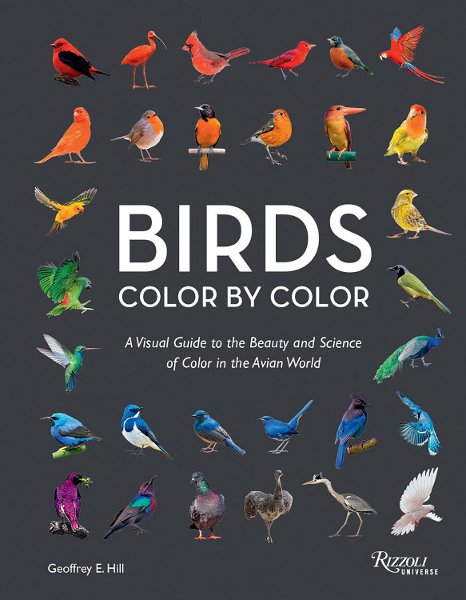
image courtesy Rizzoli Universe all rights reserved
has a rainbow array of birds perched around the title
.
All content included on this site such as text, graphics and images is protected by U.S and international copyright law.
The compilation of all content on this site is the exclusive property of the site copyright holder.
Birds Color By Color, a book review
August 2026
Look around and see that the sky is blue and the grass is green. Good enough? Or do you wonder why it is so. If curiosity needs to be satisfied you will find "Birds Color By Color" to be a fascinating read with answers to questions you might not even have thought of.
The cover of this new book, Birds Color By Color,
A Visual Guide to the Beauty and Science of Color in the Avian World
image courtesy Rizzoli Universe all rights reserved
has a rainbow array of birds perched around the title
This could have been just a picture book, merely one filled with lovely images of magnificently colorful birds. Don't get me wrong. The pictures are there, page after page, some full page, sometimes multiple images to a page, an occasional image appearing to emerge from the page. The pictures are important. For Geoffrey E. Hill, Ph.D. explaining the how and why of their color is the answer to the questions.
The first part of Birds Color By Color examines the science of color in feathers. Do not be intimidated. Also, don't skip over these important pages. Written so non-biologists may understand how feather color varies within a species and how these variations can signal sex, age, and individual identity. This section also explores how color can function both as a bold display that attracts mates or deters rivals or as camouflage. There is a discussion of colors brought with actual pigments like black melanin or carotenoids (think goldfinch and house finch, both of which I often see at feeders in my garden.) Or, the fascinating section on colors without pigments, color that isn't actually there. Very colorful peacocks create their display without actual pigment. How do they do that? Nicely explained in Birds Color By Color.
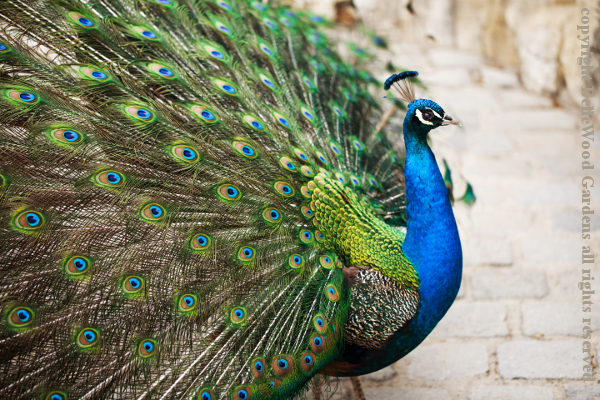
image courtesy Rizzoli Universe all rights reserved
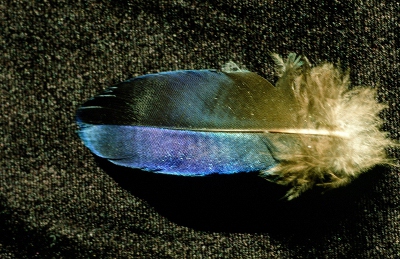
"Indian Peafowl (Pavo cristatus) have evolved intricately arranged microstructures in their feathers that give rise to their stunning coloration. These complex microstructures enable peacocks to produce the three shades of blue within each feather of the train, with precise transitions between shades such that an eyespot is formed."
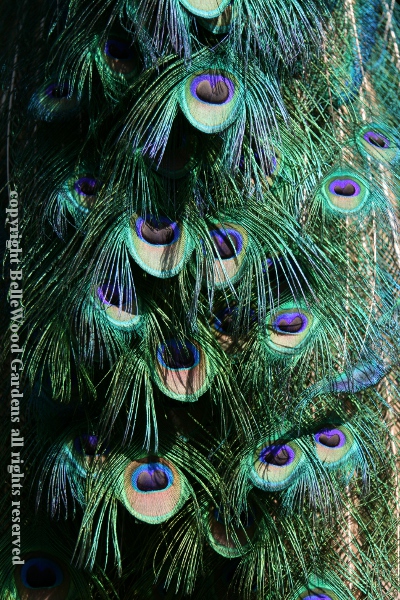
copyright BelleWood Gardens all rights reserved
Wow!
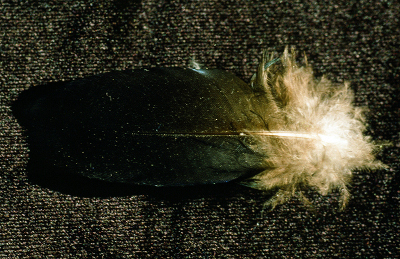 .
.
copyright BelleWood Gardens all rights reserved
These two images are of the same peacock feather. In the second image it was turned
90 degrees to the sunlight. Look at the grain in the velvet underneath it to clarify this.
Part Two presents a color-coded gallery of more than 200 species, spanning the spectrum from red to violet and including brown, black, white, and multicolored birds. Each entry highlights how particular colors arise, explains their biological purpose (whether camouflage, species recognition, or courtship), and features a concise fact file listing common and scientific names, distribution, habitat, size, and coloration.
Panatone's color of the year for 2026 is Cloud Dancer.
Birds Color By Color has a snowy owl sitting on its eponymous landscape.
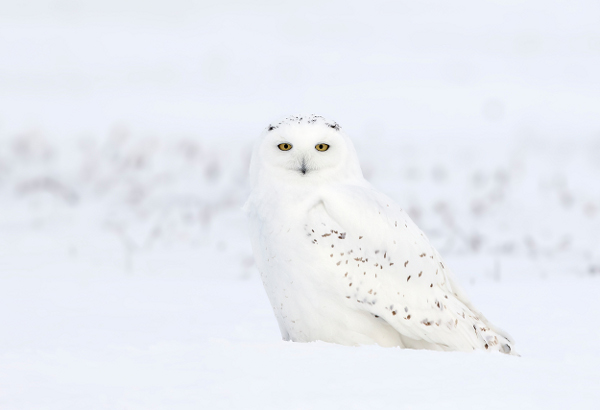
image courtesy Rizzoli Universe all rights reserved
It all but disappears. Chapter 9, on White, explains that "White appears as an absence of color,
but in fact it is the sum of all visible wavelengths - a flood of colors rather than a void."
Colors. All the world is color. Go to a paint store. So many choices! How to decide. Let someone else decide for you? Every year there is a Pantone Color of the Year. In 2026 it is PANTONE 11-4201 Cloud Dancer, described as "a billowy, balanced white shade meant to evoke serenity, calm, and a fresh start in a noisy world.." Well and good. But birds got here first.
Colors fascinate us. Vivid colors, mottled colors - we even matched the occasional bird feather color and pattern to flowers.
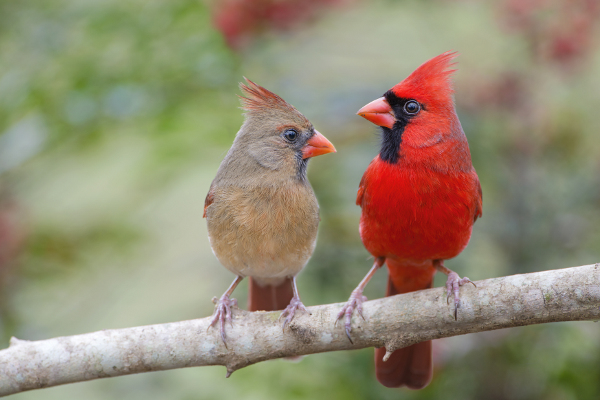
Northern cardinals are dimorphic. Male birds convert pigments in seeds they eat. How efficiently affects their color.
 .
.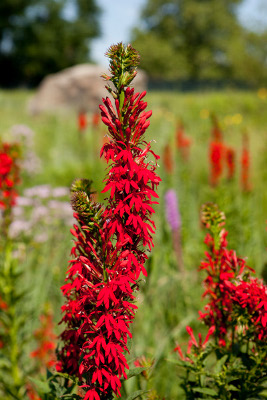
image of cardinals courtesy Rizzoli Universe all rights reserved . . . . image of cardinal flower courtesy New York Botanical Garden all rights reserved
It may influence females looking for a mate. Influenced the plantsman who named Lobelia cardinalis as cardinal flower.
Here in the Garden State there are a diversity of birds: bluejays, blue all year. Male cardinals are red all year, seaonally brighter when attracting a mate. Goldfinches are here year round, bright gold in summer and subdued olive brown in winter. Birds, color by color. Fascinating to explore the options and possibilities, the how and why of birds around the world, explored in such loving detail in Birds Color By Color.
Birds Color By Color, A Visual Guide to the Beauty and Science of Color in the Avian World
Geoffrey E. Hill, Professor and Curator of Birds at Auburn University, Alabama
Rizzoli | Rizzoli Universe
ISBN 978-0-7893-4683-4, Hardcover, $37.50
On sale September 22, 2026
If you have any comments or questions, you can e-mail me: jgglatt@gmail.com
Back to August
Back to the main Diary Page